Jacquie Ottman's
Green marketing Blog

Can Plastics Be ‘Green’?
Posted on September 09, 2016 by Jacquelyn Ottman
Changing consumption culture through the ‘zero waste’ prism has been at the top of my agenda these days. Yet, when I discovered Trucost’s new study prepard for the American Chemistry Council (ACC), “Plastics and Sustainability: A Valuation of Environmental Benefits, Costs, and Opportunities for Continuous Improvement,” (as well as an analysis by Leon Kaye here on TriplePundit), I thought to myself, are plastics really as ‘green’ as the study suggests?
I spent the weekend studying it and the “Valuing Plastics” study (2014) also by Trucost, as …Read more...
How to Cut Plastic Bag Use in New York City - And Beyond
Posted on April 01, 2016 by Jacquelyn Ottman
(Image: Timothy Krause, via Flikr)
Every time I see a plastic shopping bag blowing down a sidewalk, I make the effort to pick it up and bring it to the trash or recycling. That’s because here in New York City, plastic bags can wind up in a river, and eventually, the ocean where they can kill fish, birds, turtles. This horrifies me. And the numbers do, too.
Each year, New Yorkers use 5.2 billion plastic carry-out …Read more...
Getting to Zero Waste in New York City This Year
Posted on April 01, 2016 by Jacquelyn Ottman

(Image: Uli Seit/ New York Times)
Have you been hearing about “Zero Waste” lately? It’s an international movement that now counts among its adherents big U.S. cities like San Francisco, Los Angeles, Austin and Minneapolis. Most recently, New York City has taken its first steps down this road. On Earth Day 2015, Mayor de Blasio announced the city’s first Zero Waste plan, an attempt to rein in the costs and risks …Read more...
What NYC Can Learn From San Francisco’s Zero Waste Success
Posted on July 06, 2015 by Jacquelyn Ottman
(Image: TreeHugger)
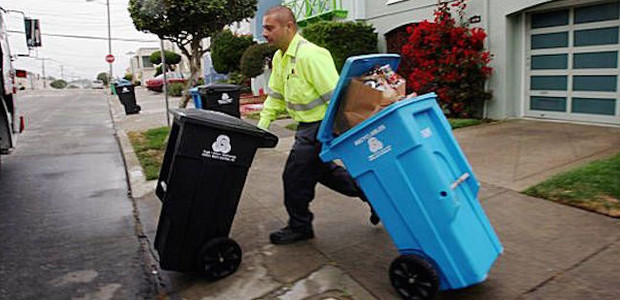
I’ve been spending quite a bit of time lately better understanding my hometown of New York City’s incredibly wasteful ways. We New Yorkers generate 11 lbs. per person of waste per day and those of us working types, 4lbs. per day. With no active landfill or incinerators (Fresh Kills was briefly re-opened to house 9/11 waste and incinerators were nixed years ago as too dirty.), we spend $300 million per year shipping our waste to Virginia, Pennsylvania and …Read more...
2015: Fresh Ideas for Engaging Consumers in Preventing Waste
Posted on January 19, 2015 by Jacquelyn Ottman

(Image: Shutterstock)
What does it take to inspire people to ‘reduce’ and ‘reuse’ in addition to recycle? The top posts submitted during 2014 submitted by members of our growing We Hate to Waste.com global community showcase a number of brand new ideas for preventing precious resources from dead-ending in a landfill.
With recycling and composting stalled at 34% across the U.S., and incinerators back atop the agendas of many U.S. cities, the timing couldn’t be better for taking a fresh look at …Read more...
To Get the Last Drop, Consumers Look to New Innovative Gadgets
Posted on May 08, 2014 by Jacquelyn Ottman
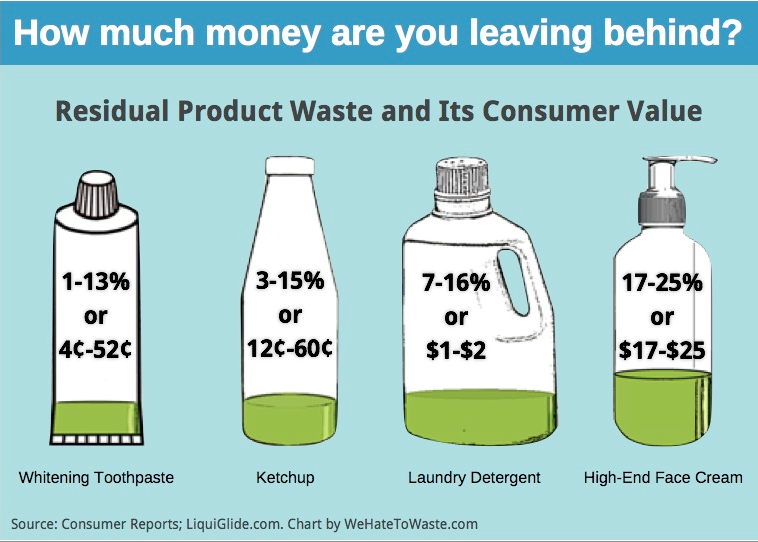
What’s your favorite way to get at that last dollop of the Crest? Do you flatten as you go? Slice the neck? What about the shampoo or conditioner? Do you add a little water and swirl? Prop the bottle upside down in a corner? You are not alone! As the Wall Street Journal has noted, an increasing number of consumers are shaking, rattling and rolling their packages in search of the last drop, ounce and morsel …Read more...
Cultures Around the World Can Inspire No-Waste LIfestyles
Posted on April 24, 2014 by Jacquelyn Ottman

Lunches delivered to workers in India in steel tiffins. (Image: Letztrend.com)
Cultures around the world possess their own unique, deeply-ingrained beliefs and traditions for minimizing waste. For instance, the Yankee Ingenuity helped America put down its early roots, and the Dutch custom of sharing unlocked ‘community’ bikes at train stations inspired bike-sharing programs in NY, Paris and other world capitals. Many …Read more...
The Newest Rule of Green Marketing: Help Consumers Live a ‘No-Waste’ Lifestyle
Posted on April 11, 2014 by Jacquelyn Ottman

The Swedes Enjoy the Most Sustainable Lifestyle in the World (Image credit: Melker Dahlstrand/imagebnk.sweden.se)
In 1988, my antenna tweaked toward an emerging trend soon to be called ‘green consumerism’. A hole in the ozone layer was discovered over Antarctica, nightly newscasts tracked the daily wanderings of the Mobro garbage barge, and air pollution clogged views of the Grand Canyon. Among the culprits: consumer products.
Alternatives needed to be found for CFCs in aerosols, polystyrene clamshells …Read more...
Sustainable Innovation 2013: Key Lessons
Posted on December 05, 2013 by Jacquelyn Ottman
Every year I head to Europe to take part in the Sustainable Innovation Conference organized by The Centre for Sustainable Design (UK) as part of its ‘Towards Sustainable Product Design’ series of conferences. Sustainable Innovation brings together pioneers, movers and shakers from around the world and across multiple industries who are changing the game of sustainable design to present their ground-breaking concepts and ideas. This year’s program, as always …Read more...
Why Consumers Care About Restaurant Food Waste
Posted on October 30, 2013 by Jacquelyn Ottman
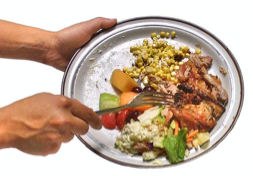
Thanks to new reports from NRDC and Harvard, indicating that 40 percent of food never makes it from the farm to a table, and that consumers are confused by “sell by” and “best by” dates, food waste is emerging as a big issue. Among the mindful consumers within our We Hate To Waste online community, food waste is now on par with long-standing environmental concerns such as water and energy supplies.
People care about food …Read more...
R-R- Redundancy — a New ‘R’ to Heed
Posted on October 23, 2013 by Jacquelyn Ottman

At lunch yesterday a colleague asked me what I thought about ‘Resilience’ as a alternative term for sustainability. I responded that I was still trying to figure out if I liked ‘Flourishing’. But I had no doubt at all about a term I coined myself recently - ‘R-R- Redundancy Avoidance’. First, a definition.
R-R- Redundancy Defined
R-R- Redundancy is what lets me close my apartment door and ‘flourish’ without speaking to my neighbors behind all the other …Read more...
New E-Report on What 2012 FTC Green Guides Update Means for Marketers
Posted on September 16, 2013 by Jacquelyn Ottman
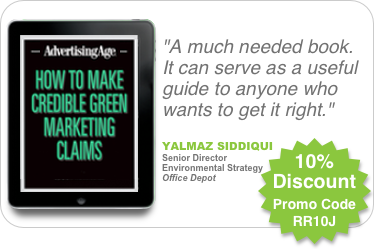
I’m delighted to announce my new e-book on what the 2012 FTC Green Guides mean for marketers. It’s entitled, “How to Make Credible Green Marketing Claims: What Marketers Need to Know about the Updated FTC Green Guides.” It is being published today by Ad Age.
I had the pleasure of collaborating on it with David Mallen, Deputy Director and chief of environmental claims of the National Advertising Division (NAD). (NAD is the industry’s self-regulatory body, an …Read more...
How To Make Waste Watching Fun, Easy — and Mainstream
Posted on April 15, 2013 by Guest Blogger, Fredrica Rudell

With 9 billion people expected on the planet by 2025, all consumers will need to be reducing, refusing, repairing, reusing, recycling, and lots of other R’s. If your consumers are not on board the waste prevention movement, take some advice from social marketers — make it easy, fun and popular. Here’s how.
Easy Does It
Curbside pickup and reverse vending machines at the supermarket make it easy to recycle newspaper and co-mingles and …Read more...
Eight Ways to Prevent Household Waste for Fun and Profit
Posted on March 05, 2013 by Jacquelyn Ottman

Ask a roomful of consumers, “Who here hates to see things go to waste?” and every hand will likely shoot up. But, if everyone hates to waste, then how come we generate so much of it? And what can we do to prevent waste from being created in the first place? Answering these questions can be profitable and fun.
Turn Waste into Business Opportunity
Despite all the attention paid to them during the past two decades, facilities to recycle and …Read more...
Sustainable Innovation 2012: Key Lessons
Posted on February 14, 2013 by Jacquelyn Ottman
The Center for Sustainable Design (CfSD), since its founding in 1995, has conducted high quality research in sustainable innovation and product design. Recognized around the globe for their sustainability expertise, the Center has worked with partners in Asia, Europe, and North America to research and develop understanding of sustainability solutions in a number of fields.
The Center has organized more than 100 conferences, workshops, and courses focussed on sustainable design and innovation. In 2012, the 17th annual Sustainable Innovation Conference: Resource Efficiency, Innivation and Lifestyles took place on October 29th …Read more...